

AI started with responses, not results: you type a prompt, it replies.
But work doesn’t end at “a good response.” Real work needs execution: moving data, triggering actions, updating systems, notifying people, and doing it reliably. That’s where the shift is happening: from prompt-based AI to AI agents, systems that can plan steps, use tools, make decisions, and complete tasks end-to-end.
And when you pair AI agents with a workflow engine like n8n, “automation” stops being a niche skill. It becomes a practical workplace superpower.
That’s exactly why NxtWave is bringing platforms like n8n into the learning experience, not as a quick demo, but as a structured pathway that trains students to build agents that can actually ship outcomes, the way modern teams operate.
In an AI-enabled workplace, the differentiator isn’t knowing tools, it’s orchestrating them.
Today’s workplaces run on connected systems: internal portals, CRMs, spreadsheets, dashboards, messaging apps, social channels, AI models, and so on. The real challenge isn’t knowing each tool in isolation. It’s knowing how to make them work together reliably, with minimal manual effort.
That’s exactly what AI agent building teaches. Not just “automation”, but end-to-end execution:
This skillset applies across roles: engineering, product, operations, analytics, marketing, and support, because every team benefits from reducing manual work and building repeatable, dependable systems that deliver results.
NxtWave + n8n: Theory to Real-World Validation
At NxtWave, n8n is not a “try-it” module. It’s a structured path to becoming AI-agent ready, built into the learning portal so learners go from theory to building end-to-end agent workflows and demonstrating proficiency through assessments designed around real-world execution.
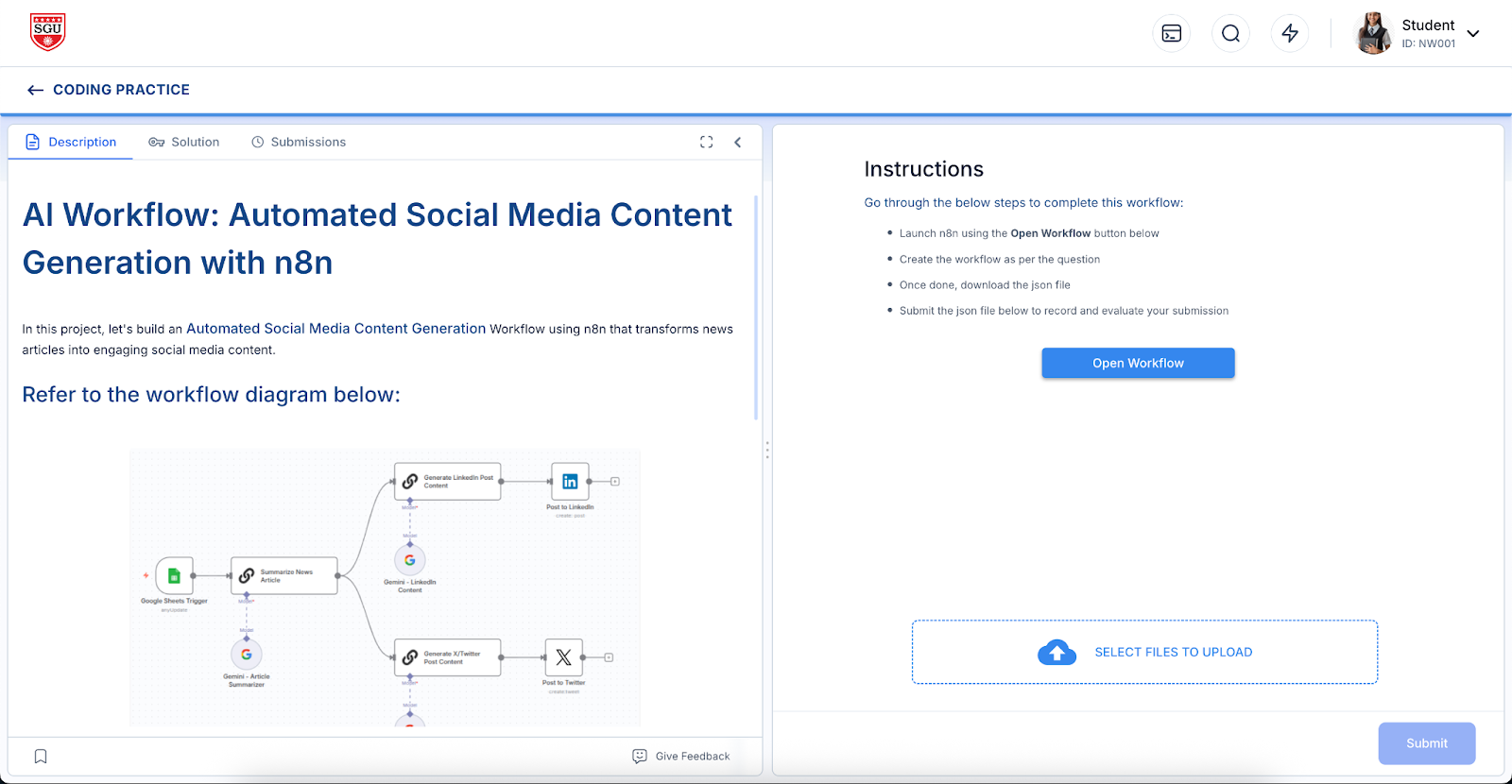
Every reliable AI agent starts with the right mental model, not random nodes stitched together.
Before students build anything, NxtWave grounds them in the fundamentals of agentic automation: how workflows are structured, how systems communicate, and how core building blocks like nodes, triggers, credentials, and data flow work together to drive execution.
The goal isn’t to memorise steps. It’s to help students think like builders who can design end-to-end agents intentionally with logic, reliability, and outcomes in mind.

Once the concepts are clear, students move into a guided, interactive n8n practice environment. Here, they work through problem statements that mirror real-world automation tasks, creating, modifying, testing, and troubleshooting workflows step-by-step.
Students practice:
This is where confidence is built, through iteration, experimentation, and hands-on problem-solving.
Finally, students validate what they’ve learned through an n8n-based exam experience designed to be both structured and transparent. Post-exam, learners get a clear review flow with easy access to reports, questions, and submitted files.
This closes the loop: students aren’t only learning automation in a sandbox, they’re being assessed in a format that reflects real constraints, real accountability, and real outcomes.
Real-World AI Agent Use Cases: Built by NxtWave Learners
Here are examples of the kinds of agents learners are being trained to build. These workflows combine tool orchestration, data flow, logic, and reliability.
Turns the latest AI news, tech updates, and upcoming AI events into a conversational podcast episode automatically.
Accepts a song idea and generates lyrics + a full music track, returning the final audio URL.
A Telegram-based travel agent that understands requests and autonomously uses tools to build a complete travel plan
These are a few workflows developed by our learners but not limited to these. Once learners understand the patterns (tool orchestration + data flow + logic + reliability), they can build AI agents for many real-world workflows across domains. All triggered by a single click: one workflow, one AI agent
Key Benefits for NxtWave Students
AI agents are quickly becoming how modern work gets done, across engineering, product, operations, analytics, marketing, and support. The ability to connect tools, move data intelligently, and build reliable workflows is increasingly part of what it means to be industry-ready.
That’s exactly why NxtWave teaches n8n: not to create “workflow hobbyists,” but to help learners become builders who can design AI agents that execute real work end-to-end.
Join NxtWave and start developing automation skills that translate directly into real-world work. Because in 2025, the skill isn’t just using AI, it’s building with it.